If you've searched for an "Africa eSIM," you've probably noticed the word Africa doing a lot of work in that phrase. Africa is 54 different countries, each with its own phone networks, regulators and coverage patterns. There is no single African mobile grid that a plan just plugs into. Understanding that one fact will save you more frustration than almost anything else in this guide.
This matters more once you're actually on the ground. A business trip to Nairobi or Johannesburg feels a lot like using your phone at home. A few days later in the Maasai Mara or a remote bush camp, and you might not get a signal at all. Same continent, same eSIM, completely different experience. Let's break down why, and how to plan around it.
What an "Africa eSIM" actually is
An eSIM (short for embedded SIM) is a small programmable chip already built into your phone. Instead of popping in a plastic SIM card, you scan a QR code or tap an activation link, and the plan loads onto the chip over WiFi. You can do this before you even leave home, so the plan is sitting ready the moment you land.
A regional or multi-country eSIM, whether it's sold for Africa, Europe or anywhere else, works by roaming onto local partner networks in each country on its list. If a country isn't on that list, the eSIM simply won't connect there, no matter how the plan is marketed. So the real question isn't "does this Africa eSIM work in Africa." It's "which specific countries and which local carriers does this plan actually roam on." Always check the coverage list against your itinerary before you buy, not after you land.
City coverage vs remote and safari coverage
Coverage everywhere in the world depends on physical infrastructure: how many towers are built, and how well those towers are connected back to the wider network. That infrastructure is always heaviest around cities and thins out the further you get from them. Africa follows this same pattern, it isn't unique to the continent.
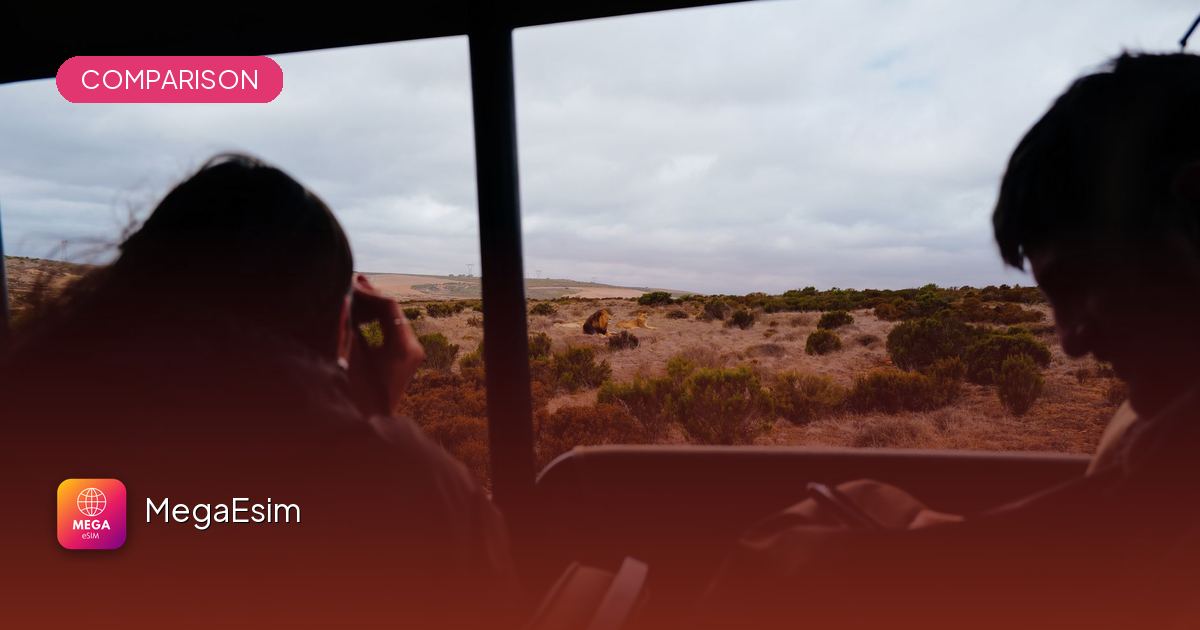
In practice, that means cities like Nairobi, Cape Town, Johannesburg, Lagos and Abuja generally have solid, dependable 4G, good enough for video calls, navigation apps, cloud syncing and everyday browsing. Head out to a safari conservancy or a remote bush camp, though, and signal often gets patchy or disappears completely. Many safari lodges rely on their own WiFi, sometimes routed through satellite, rather than the mobile network reaching that far out. If your trip includes both a city stretch and a safari, plan for two very different connectivity experiences on the same trip.
Kenya: what to expect
Kenya's biggest mobile operator is Safaricom, with Airtel Kenya as the main alternative. Safaricom is widely regarded as having the broadest reach in the country, and that includes most of the popular safari lodges and camps in the well known parks. That said, more remote conservancies off the beaten path can still have weak or no signal, so don't assume every camp on your itinerary will have coverage just because it's in a popular park.
If Kenya is on your trip, it's worth checking the network partner and coverage details before you travel, rather than assuming a general Africa plan has you covered. Our Kenya eSIM page lists exactly which network the plan roams on, so you can match it against the specific parks and towns on your route. That five minute check before you book is usually the difference between a smooth trip and a frustrating one.
South Africa: what to expect
South Africa has a more developed telecom market than most of the continent, with four main operators: Vodacom, MTN, Cell C and Telkom Mobile. Vodacom and MTN are generally seen as having the widest combined reach, with strong 4G and, increasingly, 5G in cities like Cape Town, Johannesburg and Durban. Network rankings shift a bit between reports and years, so treat "which network is best" as a general pattern rather than a fixed fact, but either way you're generally in good shape in the main cities and along the popular tourist routes.
Rural stretches and some of the more remote parks will still see weaker service, similar to the pattern in Kenya. The South Africa eSIM page breaks down current pricing and which network your plan will actually use, so you're not guessing based on the country's reputation alone.
Nigeria: what to expect
Nigeria's market runs on four operators too: MTN, Airtel, Globacom (also called Glo), and 9mobile. MTN and Airtel are typically reported as having the strongest 4G presence in the major cities, Lagos, Abuja and Port Harcourt in particular. Outside those hubs, especially in rural areas and parts of the north, coverage can drop back to patchy 3G or 2G.
If you're heading to Nigeria mainly for business in the big cities, connectivity should be reasonably reliable throughout your trip. Travelers going beyond the main hubs should look at the Nigeria eSIM page first, since the coverage footprint outside Lagos and Abuja changes the calculation quite a bit.
How much data you actually need
This depends heavily on what kind of trip you're taking. A business traveler doing video calls, syncing documents to the cloud, using maps and staying on top of email all day will burn through noticeably more data than someone mostly checking messages and posting the occasional photo from a safari vehicle.
As a rough guide: browsing, maps and messaging use just a few megabytes at a time. A single photo upload to social media is typically somewhere around 2 to 5 MB. A few minutes of video calling can use tens of megabytes. Streaming video, especially in HD, can eat several hundred megabytes to over a gigabyte per hour, so it's worth thinking honestly about how much you'll actually stream versus just browse.
Helpful Tips
- Check the exact country and network partner list on any regional plan before assuming it covers your whole trip. "Africa" on the label doesn't guarantee your destination is included.
- Install and activate your eSIM before you fly, while you still have reliable WiFi. That way it's ready the second you land, and you're not troubleshooting in an airport with no signal.
- Download offline maps for any safari or rural leg of your trip. Don't count on live data once you're away from the main roads.
- If your itinerary mixes cities and remote areas, consider whether a bigger data allowance for the city days makes more sense than trying to stretch a small plan across the whole trip.
- Ask your lodge or camp in advance whether they have WiFi, and whether it's satellite based. That's often your real fallback in deep safari country, not your eSIM.
Common Mistakes
- Assuming a "regional Africa" eSIM covers every country on the continent. It only covers the countries actually listed, nothing more.
- Booking a safari without a backup plan for connectivity, then being surprised when there's no signal for days.
- Buying based on which network "sounds best" rather than checking which network your eSIM actually roams on in that specific country.
- Forgetting to activate the eSIM before travel and then trying to do it with no WiFi and no data at the airport.
- Overpaying for a huge data allowance for a trip that's mostly maps and messaging, or underbuying for a trip full of video calls and cloud work.
Frequently Asked Questions
Will one eSIM work across Kenya, South Africa and Nigeria on the same trip?
It depends entirely on the plan. Some multi-country eSIMs do cover several African nations, but you need to confirm each specific country is on the list rather than assuming a regional label covers all three. If your trip only includes one of these countries, a single country plan is usually simpler to set up and works out well priced, since you're paying for exactly the coverage you need.
Does eSIM data work on safari?
Sometimes, but not reliably. Coverage in popular parks with established lodges can be reasonably good since those areas often sit near towers built to serve the lodges themselves. Once you're deeper into remote conservancies, though, signal is often weak or absent, and camp WiFi becomes your main option.
Can I set up my eSIM before I leave home?
Yes, and it's worth doing. eSIM installation is done by scanning a QR code or tapping an activation link over WiFi, so you can get everything set up at home and have it ready to switch on the moment you land. It takes a few minutes and means you skip the airport WiFi hunt entirely.
Which network will my eSIM actually connect to in these countries?
That depends on the roaming agreement behind the specific eSIM you buy. In Kenya that's typically Safaricom or Airtel Kenya, in South Africa it's usually Vodacom or MTN, and in Nigeria it's generally MTN or Airtel. We check and verify these partner networks as part of how we test eSIMs, so the coverage listed on each country page reflects what actually works, not just what's advertised.
Is it worth buying separate eSIMs for each country instead of one regional plan?
If your trip is mostly focused on one country, a single country eSIM is often cheaper and gives you clearer coverage expectations. A regional plan makes more sense if you're genuinely crossing several borders and want to avoid switching eSIMs mid trip, as long as every country on your route is confirmed on the coverage list.
Conclusion
The biggest thing to remember about an "Africa eSIM" is that Africa isn't one network, it's dozens of separate markets with their own carriers and coverage patterns. Cities like Nairobi, Cape Town, Johannesburg, Lagos and Abuja will generally treat you well. Remote safari country and rural stretches need more planning and a realistic backup, usually camp WiFi, for the moments your phone just can't reach a tower.
The safest approach is always the same: check the exact country list and network partner behind any plan before you travel, rather than trusting a broad regional label. If you're planning a trip that touches multiple countries, our eSIM for Africa travel page lays out current coverage and pricing so you can match the plan to your actual route before you go.


