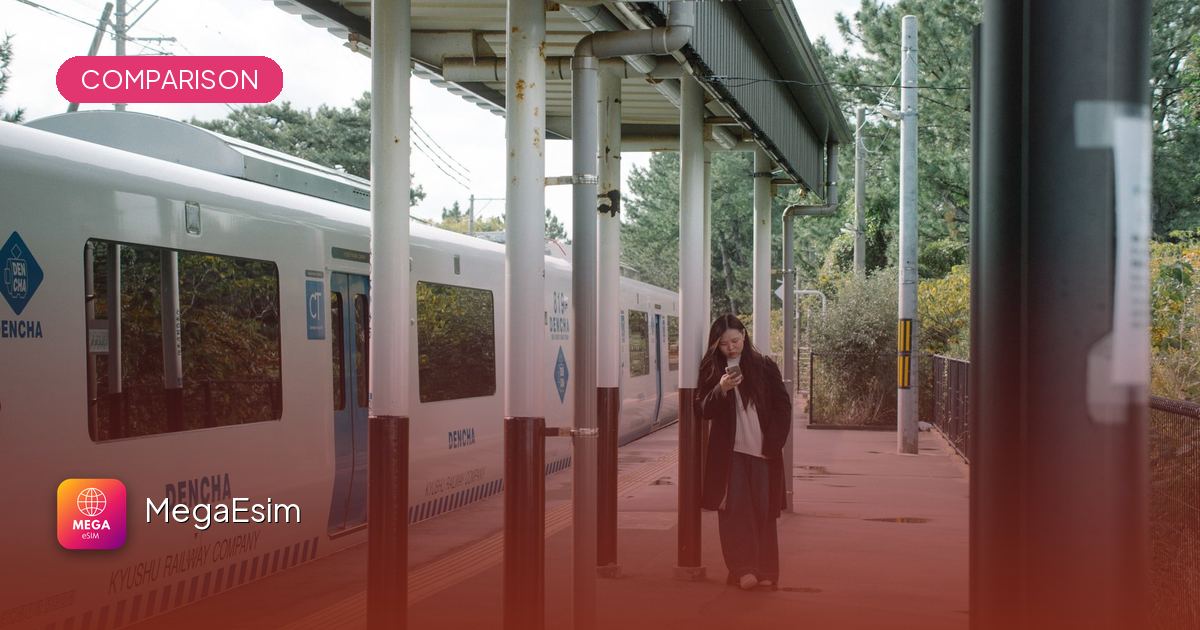
If you have searched for a Japan eSIM before, you have probably noticed that most listings sound identical. Every provider promises fast speeds, wide coverage, and an easy setup. But once you land in Japan and your maps app spins forever outside a train station in the countryside, you realize not all of them deliver the same thing. The differences are real, they are just hidden a few layers below the marketing. This guide explains what genuinely determines whether a Japan eSIM will work well for your trip, so you can choose one with your eyes open instead of just picking whichever plan looks cheapest.
What determines a good Japan eSIM
Here is the part most people never get told. Japan only has four physical mobile networks in the entire country: NTT Docomo, SoftBank, au (which is run by KDDI), and Rakuten Mobile. That is it. There is no fifth hidden network and no special infrastructure that travel eSIM companies build themselves.
Every travel eSIM, including ours, is what is called an MVNO or roaming arrangement. That is just a technical way of saying the eSIM company does not own towers or cables. It pays for the right to send your data over one or more of those four networks. This is exactly how domestic Japanese budget SIM brands like Mineo or IIJmio work too, they ride on the same four networks rather than building their own.
So when you are comparing eSIMs, the real question is not "which brand sounds more trustworthy" but "which of the four Japanese carriers does this eSIM connect to." Two eSIMs can look identical on a sales page and still perform very differently in a mountain village or a small coastal town, purely because one connects to more of the four networks than the other. This varies between providers and can change over time, so it pays to look at a plan's real carrier connections rather than assuming based on the brand name. Our own Japan plans connect to Docomo, SoftBank, au, and Rakuten, and we confirm this directly as part of our testing rather than just repeating what a supplier tells us.
Why the carrier you connect to matters
Each of Japan's four carriers has a bit of a reputation, built up over years of travelers and reviewers comparing notes. Docomo is generally seen as having the broadest overall reach, including rural areas and mountainous regions. Au tends to hold up well in the countryside too, and along train lines, which matters if you are doing a lot of intercity travel. SoftBank is usually described as strong in cities but a bit thinner once you get away from built up areas. Rakuten is the newest of the four and started from a smaller base, so it is generally considered to have more gaps outside major cities, even though it has been expanding.
None of this is an official ranking and it is not something that gets measured the same way every time, so treat it as a general pattern rather than a guarantee. But it does explain why the underlying carrier matters more than the brand name printed on the eSIM listing.
City speeds versus rural reality: 5G and 4G explained
You will see "5G" mentioned everywhere in eSIM marketing, and it is true, but it is only part of the story. In Japan, as in most countries, 5G is mostly available in dense city centers, shopping districts, and indoor spaces like train stations and malls. Once you head into smaller towns, national parks, or mountain areas, you will typically drop to 4G LTE.
That is not a problem. 4G LTE is the real backbone of mobile coverage in Japan and it reaches far more of the country than 5G does. It is plenty fast for maps, messaging, translation apps, and photo uploads, which covers what most travelers need day to day. A good eSIM should give you 5G where it is available and fall back to 4G everywhere else without you having to do anything.
It also helps to know that Japan has a lot of free public WiFi in convenience stores, train stations, and tourist spots. If you are staying mostly in cities and using WiFi whenever it is offered, your actual mobile data use will be lower than you might expect.
Working out how much data you need
Guessing your data plan is where a lot of people either overspend or run out mid trip. A simple way to think about it is by usage type, per week of travel.
- Light users who lean on hotel and cafe WiFi and only use data for occasional maps and messaging usually get by on around 1 to 3GB a week.
- Average users doing regular navigation, social media, and photo uploads throughout the day tend to land somewhere around 5 to 10GB a week.
- Heavy users who stream video, make video calls, or tether a laptop through their phone's hotspot for work often want 15 to 20GB or more, or an unlimited plan.
This is a rule of thumb rather than a precise science, since everyone's habits differ. A solo trip full of constant navigating will burn through more data than a trip where someone else knows the way, and that is completely normal. Use these numbers as a starting point for picking a plan size, then adjust next time once you know your own habits better.
Data-only plans and how calls and texts work
Almost every travel eSIM sold for Japan, ours included, is data-only. That means it will not give you a Japanese phone number to make calls or send regular texts. Your home number stays on your original SIM or eSIM, and you keep using it for calls and texts through WiFi calling, iMessage, WhatsApp, or whichever messaging app you normally use. Most modern phones support keeping two profiles active at once, known as dual SIM or dual eSIM, which is exactly what makes this setup possible.
Before you buy anything, take a minute to check if your phone supports eSIM and dual SIM use. A small number of phones, particularly some bought directly through a US carrier, are locked and cannot add a second eSIM from another provider. It only takes a minute, and it saves you from buying a plan your phone cannot use at all.
Hotspot and tethering support is not guaranteed everywhere
If your plan involves sharing your connection with a laptop or a second device, do not assume every eSIM allows this. Hotspot support genuinely varies between providers and sometimes between plans from the same provider. Some allow it freely, some restrict it, and some throttle the speed after a certain point. It is a small detail that is easy to overlook until you need it in a hotel room with no WiFi, so look at the plan's terms before you rely on it.
Price per GB matters more than the sticker price
A plan that looks cheap upfront is not always the better deal. The more useful comparison is cost per gigabyte, whether there is a daily cap or a slowdown after a soft limit, and whether unused data expires quickly. A slightly higher price with no hidden throttling and no expiry pressure often works out better in practice than the lowest number on the page. On our end, our Japan eSIM plans are tiered to match the light, normal, and heavy usage levels above, with entry pricing starting low for shorter or lighter trips and larger tiers for people who need more room.
Helpful Tips
- Install your eSIM before you fly. Activation needs an internet connection to download the profile, and airport WiFi is not always reliable, so do it from your home or hotel WiFi a day or two ahead.
- Keep your original SIM in place if it also holds your primary number, and just add the eSIM alongside it rather than replacing it.
- If your itinerary mixes cities and rural areas, lean toward a plan you know connects to Docomo or au, given their generally stronger rural reputation.
- Turn off automatic app updates and background video autoplay before your trip. These quietly burn through data without you noticing.
- If you are unsure how much data to buy, it is usually cheaper to start with a mid tier plan and top up than to overbuy an unlimited plan you will not fully use.
Common Mistakes
- Assuming every eSIM covers all four networks. Some connect to only one or two carriers, which is fine in cities but can leave gaps in rural Japan.
- Buying a plan sized for a full trip when most days will be spent on hotel or cafe WiFi. This leads to paying for data that never gets used.
- Not confirming phone compatibility first. Not every phone, especially some carrier-locked models, can install a second eSIM.
- Waiting until landing to activate. Airport WiFi can be patchy, and you want your data working the moment you step off the plane.
- Ignoring hotspot rules before relying on the eSIM to connect a laptop. This is a common surprise for business travelers.
Frequently Asked Questions
Do I need a physical SIM card as well as an eSIM in Japan?
No. An eSIM is a digital profile installed through a QR code or an app rather than a physical card, so there is nothing to insert. You will still want your original SIM or eSIM in place if you are keeping your home number active for calls and texts.
Will my Japan eSIM give me a local phone number?
Almost certainly not. Nearly all travel eSIMs for Japan, including data-only plans like ours, do not include a local number for calls or SMS. You keep your existing number for calls and texts through your usual apps, and the eSIM handles data.
Can I use my Japan eSIM to share internet with my laptop?
Often yes, but not always, and it depends on the specific plan. Hotspot and tethering support varies by provider, so look at the plan details before you count on it for work travel.
What happens if I run out of data before my trip ends?
This depends on the provider and plan. Some let you top up instantly from the app, others require buying a new plan. Confirm this before you travel so you are not caught off guard on your last few days.
Is 5G available everywhere in Japan?
No. 5G is concentrated in major cities and dense urban areas. Once you travel to smaller towns or rural regions, your connection will typically run on 4G LTE, which is still reliable and covers far more of the country.
How do I know if my phone can even use an eSIM?
Most phones released in the last several years support it, including recent iPhones and most current Samsung and Google devices, but confirm before you buy since some carrier-locked models are the exception. You can check if your phone supports eSIM in a couple of minutes.
Conclusion
The honest answer to "which Japan eSIM is best" is that it depends on which carriers it connects to, how much data matches your real habits, and whether the fine print around hotspot use and top ups fits your trip. None of that shows up in a flashy headline, which is exactly why it pays to look into the details before you buy rather than after you land.
If you want to see how we actually test every eSIM before selling it, including checking real carrier connections in both cities and quieter areas and running repeated speed tests, that page walks through our process in detail. When you are ready, our step by step setup guide walks you through installing your Japan plan in a few minutes, and you can always read what other travelers say before you decide.


