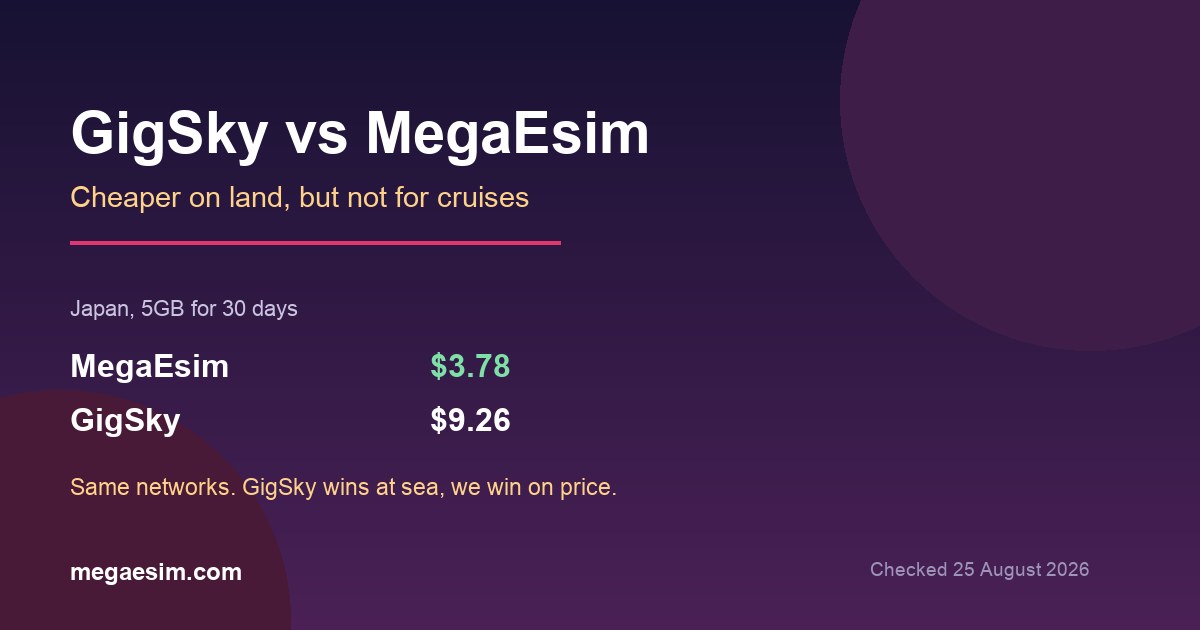
GigSky is one of the older names in this category. They sell through Visa card benefits, they run on cruise ships and aircraft where most eSIMs do not work at all, and they give away a free 100MB trial so you can test before paying.
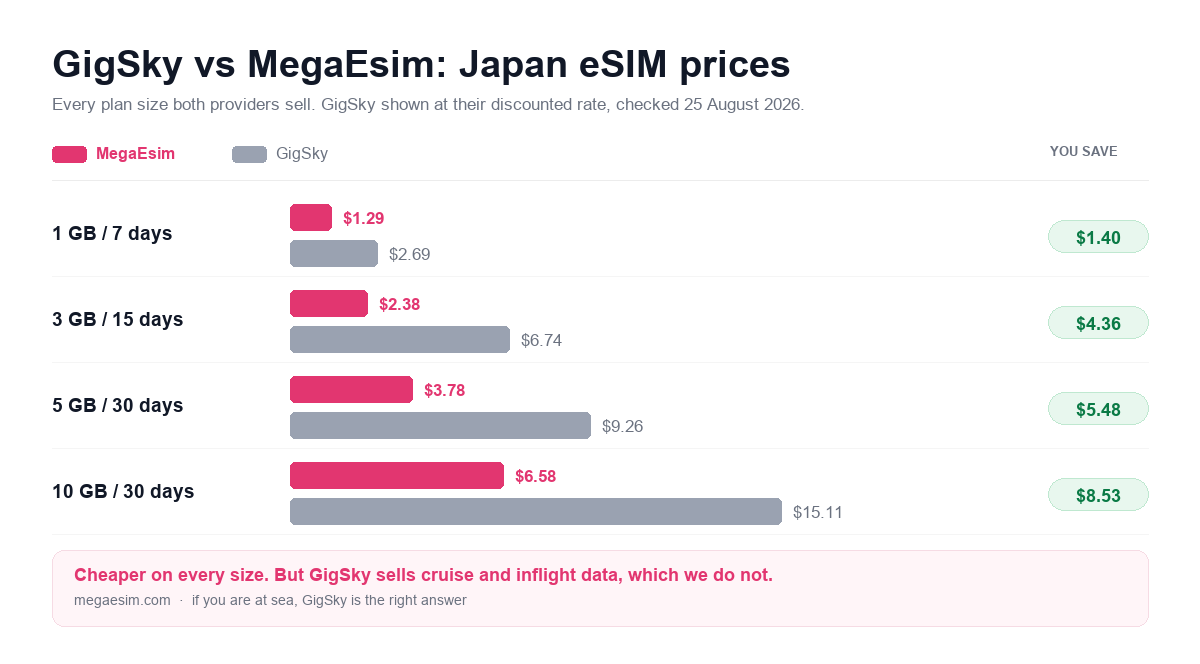
All of that is genuinely useful. What it is not is cheap. On the four plan sizes we both sell in Japan, GigSky is between two and two and a half times our price, and that is using their discounted prices rather than their list ones.
Every price in this article was read off each provider’s own website on 25 August 2026, in US dollars, from a US connection. Providers change prices often, so check the live page before you buy. Where the other provider is the better choice, this article says so.
Japan, read from both providers’ own sites on 25 August 2026, in US dollars. GigSky figures are their discounted prices.
Is MegaEsim cheaper than GigSky?
Yes, on all four sizes both companies sell in Japan. A 5GB plan for 30 days is $3.78 with us and $9.26 with GigSky. The pattern holds from the smallest plan to the largest.
Worth being fair here. The GigSky figures above are their discounted prices, shown with a limited time offer on their site. Their list prices are higher: $10.29 for the 5GB plan and $16.79 for the 10GB. We used the lower numbers because that is what a buyer pays today.
What does GigSky do better than MegaEsim?
Three things, and two of them we simply cannot match.
Cruise ships and aircraft. GigSky sells maritime and inflight plans. If you are on a cruise, that is not a nice extra, it is the only thing that works. We do not offer this at all.
Visa card benefits. If your card includes GigSky data, some of it may already be paid for. Free is cheaper than anything we can offer, so check your card before you buy from anyone.
A free 100MB trial with no card required. That is a genuinely good way to test whether an eSIM works on your phone before spending money. We do not have an equivalent.
Is GigSky unlimited data worth it?
They sell unlimited by trip length alongside the fixed plans. Seven days of unlimited in Japan is $22.09 and thirty days is $55.67.
Their fair use policy is stated plainly on the page, which is more than many competitors manage: data is never cut off but slows after 3.5GB per day, and full speed returns the next day. That is a reasonable allowance and an honest way to describe it.
Whether it is worth it depends entirely on your usage. Seven days of unlimited at $22.09 against our 5GB plan at $3.78 is a large premium, and most travellers do not finish 5GB in a week. If you stream or tether daily, the maths changes.
Why is GigSky more expensive if the network is the same?
Partly because they are not only selling data. Maritime and inflight coverage costs real money to provide, the Visa partnership has commercial terms behind it, and a free trial has to be paid for by the people who do buy.
That is a legitimate business. It is just worth knowing that on a normal land based trip in a normal country, you are helping fund capabilities you are not using.
We do none of that. No cruise plans, no card partnerships, no advertising. The saving comes out of overheads rather than out of your connection, which is explained on our why our plans cost less page.
Who is GigSky actually for?
Three groups, clearly.
Cruise passengers. If you are at sea, this is not a comparison at all. We do not sell maritime data and most travel eSIM providers do not either. Buy GigSky.
Visa cardholders with data included. Check your card benefits before buying anything from anyone. Data you have already paid for through an annual fee beats every price in this article.
People who want to test before paying. The free 100MB trial is a sensible way to confirm your phone handles eSIM properly, especially if you have never installed one.
For a normal land trip in a normal country, paid out of your own pocket, the price difference is hard to justify.
What does the difference add up to over a year?
Six trips a year on a 5GB plan is $55.56 with GigSky at their discounted rate, or $61.74 at list. With us it is $22.68. That is a difference of between $33 and $39 for identical data on identical networks.
For a family of four on one trip it is four plans, not one, so the gap multiplies immediately.
If you are cruising even once in that year, GigSky earns some of it back by being the only option that works at sea. That is a real trade rather than a rhetorical one.
Who should buy which?
| If this is you | Pick | Why |
|---|---|---|
| You are going on a cruise | GigSky | We do not sell maritime data at all |
| Your Visa card includes GigSky data | GigSky | Already paid for, nothing beats that |
| You want to test eSIM before paying | GigSky | Free 100MB trial, no card required |
| You want the lowest price for a normal trip | MegaEsim | Two to two and a half times cheaper on every matching size |
| You want unlimited on a short heavy trip | GigSky | Clear 3.5GB per day policy, priced accordingly |
| You need a phone number for bank texts | Neither | Keep your home SIM active alongside |
Half that table goes to GigSky, and it should. They do things we do not do, and on a cruise ship we are simply not an option.
Is the coverage and speed the same?
In the destinations we both sell, usually yes. Both GigSky and MegaEsim buy wholesale roaming access from the same local operators, so in Japan that means Softbank and its partners either way.
Neither provider throttles a standard per gigabyte plan. Your speed comes from the mast you are standing under and the phone in your hand, not from the logo on the plan.
Before buying from anyone, check which local network the plan uses. Every one of our country pages names the operators, for example the Japan eSIM page. If a provider will not tell you, that is worth noticing.
Which is easier to install?
Near identical, because eSIM installation is a GSMA standard rather than anything either company invented. You buy, you get a QR code, you scan it in phone settings, and you switch on data roaming when you land.
The thing that matters more than the provider is timing. Install at home on wifi before you fly. The plan does not start counting until it first connects abroad, so there is no penalty for installing early and a real risk in leaving it until you land. Our setup guide covers iPhone and Android.
Do either give you a phone number?
Neither does as standard. Both GigSky and MegaEsim sell data. Calls and texts work through WhatsApp, iMessage or any internet calling app, but a bank text sent to your home number will not arrive, and you cannot dial emergency services on the plan.
Keep your home SIM in the phone with its data roaming switched off. You keep your number for texts and emergencies, and the eSIM carries the internet.
What happens when you cross a border?
A single country plan stops at that country's edge, which looks identical to a fault. Buy a Japan eSIM, take the ferry to South Korea, and you have no data until you buy something else.
Both providers solve it with regional plans covering a group of countries on one profile. If your trip touches more than two countries, a regional plan is almost always cheaper than buying each separately.
The trap is assuming a regional plan covers every country in the region. They rarely do. Ours are printed in full on the Europe and Asia pages, including the countries that are not included.
How were these prices checked?
Worth stating, because comparison articles have a reputation for quoting whichever number flatters the author.
Every GigSky figure was read from their own live website on 25 August 2026, from a United States connection with the currency showing US dollars. That detail matters. On a United Kingdom connection several providers in this category display pounds, and quoting that number as dollars understates their price by roughly a third.
The MegaEsim figures come from the same database our checkout reads. None of these are launch offers or recommended retail prices. GigSky prices are their discounted rates, which is the lower of the two figures they show.
Prices move. If you are reading this months later, treat the shape of the comparison as the durable part and check the live numbers yourself.
How much data do you actually need?
This decides more than the price comparison does, and most people guess badly.
Maps, messaging, a few searches, some scrolling and the occasional video comes to roughly 300MB to 700MB a day for most travellers. On that basis a week is about 3GB to 5GB and two weeks about 6GB to 10GB.
Streaming video daily or tethering a laptop changes it completely and pushes you towards a larger plan or an unlimited one. Your phone already knows the answer: settings will show last month’s usage at home, and travel use is usually lower because you are outside walking rather than on the sofa.
Our guide on how much data you need breaks it down by activity with real numbers rather than guesses.
What do people get wrong when they switch provider?
Three mistakes, over and over.
Deleting the old eSIM too early. There is no need to remove the old profile before installing a new one. Modern phones hold several. Keep the old one until the new one is connected, then tidy up.
Installing at the destination. Install before you fly, while you have reliable internet. The profile download needs a connection, and the moment you need it most is the moment you are least likely to have one.
Leaving the home SIM’s data roaming on. This is the expensive one. The eSIM handles your data, but if your normal carrier’s roaming stays enabled the phone can quietly fall back to it and bill you at full rate. Switch roaming off on the home line and on for the eSIM line. Our roaming switch guide has the exact steps.
What happens when something goes wrong?
We are small enough that an email reaches a person who can look at your actual eSIM, and we answer within 24 hours. There is no queue to escalate through and nobody needs permission to fix something.
Being small is not automatically better. A larger provider covers more hours and more languages, and on a bad day at an airport that matters.
Most problems are not the provider at all. Nine times out of ten it is data roaming switched off or the phone using the wrong line for data, which is fixable in under a minute once you know where to look.
What should you check before buying any travel eSIM?
Which network you will be on. A plan is only as good as the local operator behind it.
Whether the displayed price is the checkout price. Put the plan in the basket and look at the total before entering card details.
When validity starts. On most plans the clock starts when the plan first connects, not when you buy. Some providers start it at purchase, which quietly costs you days.
What happens when the data runs out. Some plans stop dead, some slow down, some let you top up without reinstalling.
The refund terms for an eSIM you never install. Ours can be refunded for six months if the QR code was never scanned. Check what the other provider offers.
- ✓197 countries, plans from $1.29
- ✓Hotspot included on your normal allowance
- ✓The price on the page is the price charged
- ✓Unused eSIM refundable for 6 months
Frequently asked questions
Is GigSky cheaper than MegaEsim?
No. On all four plan sizes both companies sell in Japan, MegaEsim is lower. A 5GB 30 day plan is $3.78 with us against $9.26 with GigSky, using GigSky's discounted price on 25 August 2026.
Does GigSky work on cruise ships?
Yes, and this is their real advantage. GigSky sells maritime and inflight plans, which most travel eSIM providers including us do not offer. If you are cruising, GigSky is the sensible choice.
Does GigSky throttle unlimited plans?
Their site states that data is never cut off but slows after 3.5GB per day, with full speed returning the next day. That is clearer than most providers in this category.
Is the GigSky free trial worth using?
Yes. A free 100MB plan with no card required is a genuinely useful way to confirm an eSIM installs and connects on your phone before you spend anything, whoever you eventually buy from.
Is MegaEsim a real company?
Yes. We trade as Soha Trading LLC-FZ, registered in Dubai, United Arab Emirates, and the full address is on our terms page. Payments go through Stripe.
Can I keep my normal phone number?
Yes. A travel eSIM is data only and sits alongside your existing SIM. Keep your home line active for calls and texts, switch its data roaming off so your carrier cannot bill you, and let the eSIM carry the internet.
Is the price I see the price I pay?
On our site the figure on the page is read from the same database as the checkout, so it does not change at payment. Always confirm this with any provider before you buy, because teaser pricing is common in this category.
What if the eSIM does not work when I land?
Nine times out of ten it is data roaming switched off, or the phone using the wrong line for data. Our eSIM troubleshooting guide works through the fixes in order, whichever provider you bought from.
GigSky is a trademark of its owner. MegaEsim is not affiliated with, endorsed by, or sponsored by GigSky. Prices were read from each provider's own website on the date stated above and are shown in US dollars.


