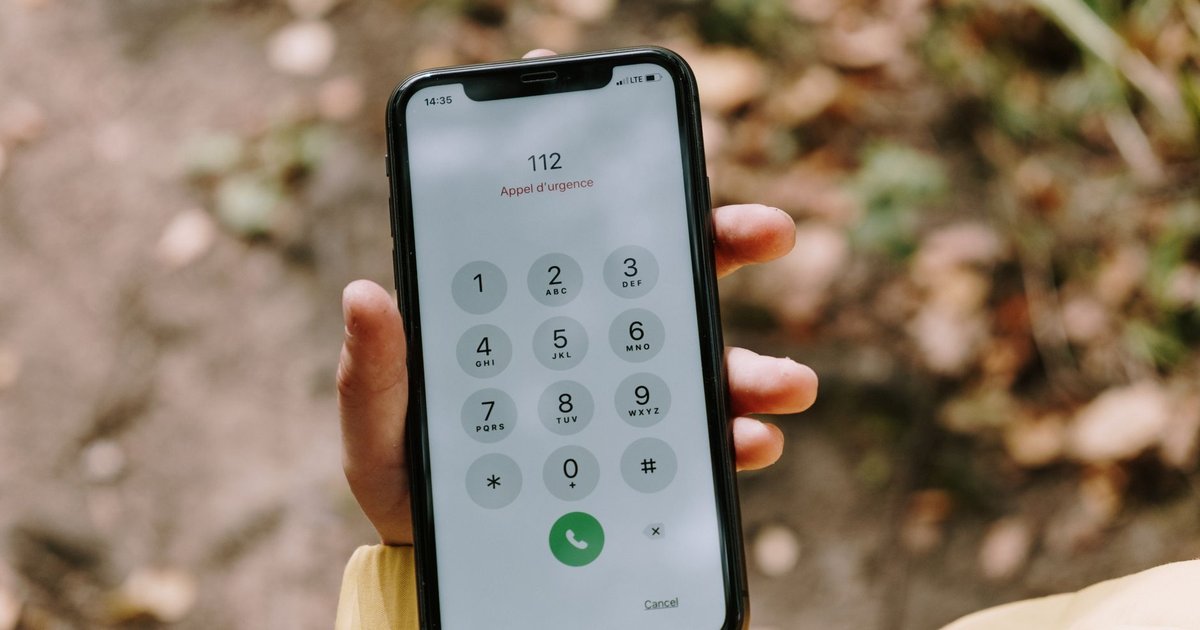
You are driving alone through Italy or Spain on a data only eSIM, and somewhere on the second day the question arrives: if the car goes off the road, can this phone even call for help? The plan has no number. Every page you find says the same short thing, that 112 works without a SIM, and then stops.
The short thing is mostly right. A data only eSIM can reach 112 anywhere in Europe, because the phone and the network handle emergency calls outside your plan altogether. But there are three catches nobody spells out, and a solo driver should know all three before setting off: a handful of countries refuse calls from phones with no SIM, 112 may have no way to ring you back, and a phone with two lines can send the emergency operator's callback straight to voicemail.
The short answer: 112 connects, with three catches
112 is the single European emergency number. The European Commission's policy page, last updated 23 June 2026, says it is free, works from fixed and mobile phones everywhere in the EU, and sits alongside national numbers such as 999 in the UK or 15 and 17 in France. Switzerland and other non EU countries use it too.
A data only eSIM does not dial it. Your phone does, through any network it can see, and the eSIM company is not part of that call. The UK operator EE says it plainly on the page for its own data only travel eSIM: even though it is a data eSIM, you can still make emergency calls to 999 and 112. Airalo's support account told a Reddit user the same in December 2023, then told another in November 2024 that data only eSIMs cannot make calls, which is a fair summary of how confused the brands themselves are.
How an emergency call leaves your phone
Mobile networks keep what the European telecoms regulators' group CEPT calls a Limited Service State. Its ECC Report 324, approved on 24 November 2021, describes it as the mode that lets emergency calls be made from devices with no SIM at all, and from devices with a valid SIM that cannot fully register on the network in front of them. A data only eSIM is the second case. It is a real SIM with a real subscriber identity; it simply has no voice service and no number. The network recognises 112 and connects the call anyway.
Apple's iPhone guide adds the phone side. If your carrier's network is unavailable, the iPhone shows and tries to route emergency calls through other networks where available. So even if your eSIM has no partner in the valley you are standing in, a rival network's mast can carry the 112 call.
The same guide carries a warning that matters for the next section: some networks may not accept an emergency call if the iPhone has no SIM card, or if the SIM is PIN locked. Both are worth remembering, because a data only eSIM is not SIM free, and a locked SIM is worse than none.
Country by country: where a phone with no SIM can call 112, and where it cannot
This is where the blanket "112 works without a SIM" advice breaks. ECC Report 324 surveyed European regulators in 2019. Thirteen said SIM free emergency calls are allowed, among them Austria, Finland, Hungary, Iceland, Ireland, Latvia, Lithuania, Poland, Portugal, Spain and Sweden. Five said they are not: Bulgaria, France, Germany, Romania and Switzerland. The report's reason for the bans is hoax calls, and the habit of using 112 to test second hand or stolen phones.
The national pages agree. Germany's emergency call regulation, the NotrufV, states that emergency connections from mobile phones without a SIM are not permitted. Switzerland's federal government stopped SIM free 112 calls on 21 July 2000 after police call centres were overloaded. France is reported to have blocked them since 2004; we found no regulator page that says so, so treat the date as reported. Belgium's health ministry page, updated 21 November 2025, says a mobile can call 112 without an active subscription but with a SIM card. In the UK, networks only accept 999 or 112 from a phone with an active SIM, according to an Ofcom position from 2009 that we could only read as quoted elsewhere.
On the other side, the Dutch government says 112 can always be reached without credit and without a valid SIM. Italy's interior ministry says the same for its 112 service, and Spain's regional 112 pages say a call goes through without coverage from your own operator, without the PIN and without a SIM.
| Country | 112 from a phone with NO SIM | 112 from a data only eSIM | Source |
|---|---|---|---|
| Germany | Not permitted | Yes, it is a valid SIM | NotrufV section 4 |
| France | Reported blocked since 2004 | Yes | Pompier Actu, May 2025; no regulator page found |
| Switzerland | Stopped 21 July 2000 | Yes | Swiss federal press release |
| Belgium | A SIM is required | Yes | SPF Sante publique, November 2025 |
| United Kingdom | Active SIM required | Yes; EE confirms for its data eSIM | Ofcom 2009 as quoted; EE Travel eSIM page |
| Bulgaria, Romania | Not permitted | Yes | ECC Report 324 |
| Netherlands, Italy, Spain | Yes | Yes | Rijksoverheid; Prefettura di Genova; 112 Cantabria |
| Austria, Finland, Hungary, Iceland, Ireland, Latvia, Lithuania, Poland, Portugal, Sweden | Yes | Yes | ECC Report 324 |
The column that matters for you is the third one. A data only eSIM sits on the "yes" side of every row, because the ban is on phones with no SIM, and yours has one. The confusion online comes from guides that read "Germany requires a valid SIM" and conclude a data only eSIM will fail there. It will not, for the reason EE gives about the UK.
The callback problem: why 112 may not be able to ring you back
When an emergency call carries no caller number, the operator cannot ring back if the line drops. ECC Report 324 says it directly for SIM free calls: they get the same network priority as any other emergency call, but call back is not possible because no caller line identity is available. Finland went as far as inventing an alternative identity for those calls, built from the phone's IMEI, so its operators can at least recognise a repeat call; it still gives them no number to dial.
A data only eSIM has an identity on the network but no dialable number, and nothing we read tested whether a European 112 centre can return a call to one. So assume it cannot. Say where you are first, stay on the line until they tell you to hang up, and keep the phone in your hand afterwards. Apple's guide says that after an emergency call the iPhone temporarily switches off Do Not Disturb, Silence Unknown Callers and Screen Time so a callback can get through; that only helps if there is a number to call.
Assume they cannot call you back On a data only line, treat every 112 call as one shot. Location first, then what happened, then the number of people involved. Do not hang up to look something up.
Will they know where you are?
Two kinds of location reach a 112 centre. The network's own cell location, which is coarse, and the phone's handset location, which the EU calls AML and which is typically accurate to between 5 and 50 metres according to the emergency services association EENA. AML travels either as a hidden SMS or over HTTPS. EENA's April 2020 FAQ says it mostly does not work for SIM free devices, because the SMS route needs a number and the data route needs a data connection, and that for international roamers it depends on the country's set up, with Android able to use HTTPS. It does not address iPhones on roaming lines.
A data only eSIM has a data connection, so the HTTPS route is at least possible where the country supports it; the report does not analyse that case and neither will we. The law is on your side in principle. EU rules require caller location, network and handset derived, to reach the emergency centre free of charge for every 112 call, and the Court of Justice ruled in 2019, after a girl kidnapped in Lithuania called 112 ten times from a car boot without being located, that member states must make location available even when the phone has no SIM. Since 17 March 2022 every smartphone sold in the EU must be able to use Wi-Fi and Galileo satellite data for emergency location.
In practice, say the road number, the last town sign and what you can see. A phone's blue dot in a maps app is the fastest way to read your own coordinates aloud, and it works on the eSIM's data.
Emergency SOS with two lines: iPhone and Android settings that matter
Most travellers on a data only eSIM also carry their home SIM in the same phone, which is our recommended setup and the one our dual SIM guide describes. It changes the emergency picture in one specific way that Apple documents and almost nobody repeats.
Apple's dual SIM guide says that if you have not turned on Wi-Fi Calling for a line, any incoming calls on that line, including calls from emergency services, go directly to voicemail when the other line is in use, and you will not receive missed call notifications. So if 112 has your home number from an earlier call and tries to ring it while you are on another call, the callback can vanish into voicemail. Apple does not say which line Emergency SOS dials on a dual SIM iPhone, so neither will we. What it does say is that the phone routes emergency calls through other networks if the carrier's own is unavailable.
- iPhone: Settings, Emergency SOS. Turn on Call with Hold and Release, or Call with 5 Presses, and check the emergency contacts in Health so they are texted your location after a call.
- iPhone: Settings, Cellular, tap the home line, and turn Wi-Fi Calling on before you leave home if your carrier allows it abroad, so a callback to that line does not go to voicemail while you are on the other one.
- Android: Settings, Safety and emergency, Emergency SOS. Pressing the power button five times starts it on Android 12 and later; it does not work in airplane mode or Battery Saver.
- Samsung: same menu, side button five times. Samsung's page says the device must have an active SIM to send an SOS alert with your location to contacts, which the data only eSIM satisfies.
- Do not test with a real call. Apple's own advice if you trigger SOS by accident is to stay on the line and tell the operator it was a mistake.
One more thing to unlearn. The SOS label in the iPhone status bar, the one that means you can still call emergency services, exists only in Australia, Canada and the United States. In Europe you will see No Service instead, and emergency calls may still connect.
What changed in 2025 and 2026: 2G and 3G switch offs and roaming failures
Emergency calls used to fall back to 2G or 3G when a phone could not place a 4G voice call. Those networks are being switched off across Europe, and the fallback is disappearing with them. On 1 December 2025 EENA wrote to the European Commission's Vice President Virkkunen reporting growing cases through 2025 of people unable to reach emergency services, especially while roaming, because some phones cannot do 4G voice and because one roaming architecture does not give full access to emergency services while roaming. Its briefing on the shutdowns adds that a callback from the emergency centre is not guaranteed in every 4G and 5G scenario.
Sweden's regulator ordered three operators to identify phones that support 4G calling but cannot make emergency calls over it, warn their owners, and block them in early 2026. Ofcom in the UK opened a 999 access compliance programme in November 2025, after fining BT, Gigaclear and Vonage, and closed it in June 2026 with guidance on end to end test calls. The practical point for a traveller is that an older or cheaper phone may not complete a 112 call on a modern network abroad at all, whatever SIM is in it. If your handset is more than a few years old, that is a reason to carry a second one.
No signal at all: satellite SOS and the button in your hire car
Where no network exists, two things still work. Apple's Emergency SOS via satellite, on iPhone 14 and later, is available in Europe in Andorra, Austria, Belgium, France, Germany, Iceland, Ireland, Italy, Luxembourg, the Netherlands, Portugal, Spain, Switzerland and the UK, according to Apple's page published 22 July 2026. It needs no cellular or Wi-Fi coverage and is free for two years after the phone is activated. Greece, Croatia, Poland, Czechia, Hungary, the Nordic countries except Iceland, the Baltics and Turkey are not on that list. Google's Satellite SOS on Pixel 9 and later, except the 9a, covers thirty European countries including those, and starts when you dial the local emergency number with no network available.
Then there is eCall. Every new car model approved in the EU after 31 March 2018 must carry a 112 button that calls the emergency centre automatically after a serious crash or manually when pressed, sending the car's location, time, direction and identification. A recent hire car has its own 112 line built in, with no phone involved. Find the button before you drive off.
Before you drive off Find the SOS button in the car. Check your phone model against Apple's or Google's satellite list for the country you are in. Download the offline map for the region so your position shows even with no data.
The calls 112 does not cover
An emergency call is the one call a data only eSIM handles. The calls a real trip generates are the other kind: the hotel that needs to know you are late, the breakdown service, a non urgent report to the police, the clinic, your embassy, and the neighbour who found your lost bag. Most of those are ordinary numbers, and a data only line cannot dial them or take the return call. Some are short codes that do not exist outside their own country. Norway's 116117 non emergency medical line, for example, cannot be reached from a foreign number, according to a Travel Stack Exchange answer from August 2024; the ward's regular number is the way in.
Embassies publish lines that work from abroad. The UK Foreign Office's emergency number for British nationals overseas is 020 7008 5000, option 1, per its gov.uk page. The US State Department lists numbers for citizens in an emergency abroad; we could not load its page today, so check it before you travel. WhatsApp states that emergency service numbers cannot be reached through the app, and Wi-Fi Calling needs a voice line the data only eSIM does not have.
Where a European number plan fits, and where it does not
This is the honest shape of our own product. Our Europe plans are data only, and on them 112 behaves exactly as this post describes: the phone dials it, the network carries it, and nobody can call you back on that line. Our post on what data only actually means covers the rest of what you give up.
The Europe Number plans add a European mobile number with unlimited calls within the 34 covered countries, 200 texts on the 20 GB plan for $24.99, and unlimited texts from 50 GB upward, all for 30 days. That number is what the hotel, the breakdown service and the embassy can dial, and what a 112 operator has a chance of ringing back, although we have not tested a 112 callback to one and will not promise it. It is a European number rather than a number from the country you are visiting, and its country is set at activation. It works inside the 34 countries only, France and Turkey included; the unlimited data plans run on a different area that excludes both. The wider question of when you need a number at all is in our post on whether you need a phone number in Europe.
What no number plan changes is the emergency call itself. 112 works the same on every plan we sell, and on a phone with no plan at all in most of Europe. The number is for everything after.
Quick answers
Can I make an emergency call without a SIM card in Europe?
It depends on the country. The Netherlands, Italy, Spain, Austria, Ireland, Portugal, Poland, Sweden, Finland and others allow 112 from a phone with no SIM. Germany, France, Switzerland, Belgium, the UK, Bulgaria and Romania refuse SIM free calls, mostly because of hoax calls. A data only eSIM counts as a SIM, so it can call 112 in all of them.
Can I make calls with a data only eSIM?
Not ordinary calls: there is no number and no voice service, so a hotel or taxi cannot be dialled and cannot ring you. Calls over WhatsApp, FaceTime or similar apps work over the data. 112 is the exception, handled by the phone and the network outside the plan, and it connects on a data only eSIM across Europe.
Why does my eSIM say emergency calls only?
The phone can see a network but the eSIM has not registered on it. Usual causes are data roaming switched off for that line, the wrong network chosen by hand, or a plan that does not cover the country you are in. Emergency calls still work in that state; data does not. Toggle airplane mode, check roaming is on for the eSIM line, and reselect the network.
Will 112 be able to call me back on a data only eSIM?
Assume not. A call with no caller number cannot be returned, which the European regulators' report states outright for SIM free calls, and no source we found has tested a callback to a data only eSIM. Give your location first, stay on the line until told otherwise, and keep the phone free afterwards in case they can.
Can I call 911 without a SIM card abroad?
In the United States and Canada, carriers must connect 911 from any phone, SIM or not. That is a North American rule and does not carry to Europe, where seven countries refuse SIM free calls. Dial the local number, 112 in the EU; many phones translate 911 to the local emergency number, but do not rely on that.
Does Emergency SOS work with two lines on an iPhone?
Yes, and Apple's guide adds one warning: a line without Wi-Fi Calling turned on sends incoming calls, including calls from emergency services, straight to voicemail while the other line is busy, with no missed call alert. Turn Wi-Fi Calling on for your home line before you travel where the carrier allows it. Apple does not say which line SOS dials.
Does the SOS icon on my iPhone mean I can still call 112?
That status bar label exists only in Australia, Canada and the United States, according to Apple. In Europe you will see No Service instead, which does not mean an emergency call will fail; the iPhone still tries other networks for 112. If the phone shows a carrier name but no data, the eSIM line is registered and the call should connect.
Sources
- European Commission, 112 policy page, updated 23 June 2026
- CEPT ECC Report 324 on emergency calls from SIM less devices, November 2021
- Germany, Notrufverordnung, read 14 September 2026
- Rijksoverheid, what happens when I call 112, read 14 September 2026
- EE, UK Travel eSIM FAQ on emergency calls, read 14 September 2026
- Apple, Use Dual SIM on iPhone, read 14 September 2026
- Apple, Emergency SOS via satellite availability, published 22 July 2026
- EENA letter to Vice President Virkkunen, 1 December 2025
- ✓Fixed price plans from $1.29, no surprise bills
- ✓Home SIM stays on for calls and bank codes
- ✓Installed before you fly, live when you land
- ✓Support answered around the clock


